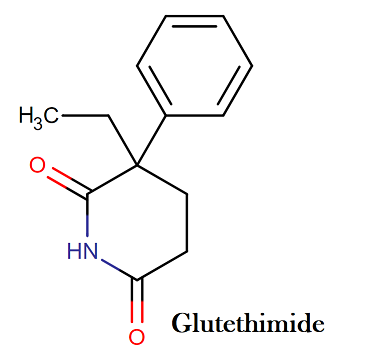
Glutethimide (branded Doriden) is a non-barbiturate sedative-hypnotic medication introduced by Ciba Specialty Chemicals in 1954, FDA-approved, indicated, and marketed as a sleeping pill under the brand Doriden beginning in 1957. Initially considered a preferable and safer prescription drug alternative to barbiturate salts, by the 1970s, glutethimide was recognized as having a similar abuse, misuse, dependency. and addiction profile as barbiturates and non-barbiturate central nervous system (CNS) CNS depressants hypnotics, and tranquilizers commonly in use at the time (e.g. methaqualone, ethinamate, ethchlorvynol, methyprylon). Abrupt cessation of glutethimide use results in rebound effects similar those found in barbiturate withdrawal.
In recreational quantities, Doriden or even the generic substance was colloquially called "Cibas" was manufactured as an oral medicine in the dosage form of a scored, white tablet containing 500 mg of glutethimide, anwas available in the United States until production ceased and the product discontinued and withdrawn from the market in 1993. Since 2013, the U.S. Drug Enforcement Administration has limited annual production to three grams, equivalent to six Doriden tablets, suggesting current use is limited to small-scale research.
The substance was discontinued in Hungary in 2006.
Mechanism of Actione and Use
Glutethimide is a CYP2D6 enzyme inducer, enabling the body to convert higher amounts of codeine to morphine, frequently leading to s users ingesting the substance with Tylenol 4 (codeine/acetaminophen).
Recreational misuse
Glutethimide was often combined with products containing codeine, which metabolizes upon ingestion into morphine.colloquially called "hits," "pancakes and syrup," and most frequently "Dors and 4s", a highly potent and often lethal combination, resulting in fatal respiratory depression.
The drug became increasingly harder to access in the 1970s, increasing demand for glutethimide in such urban centers as Boston, Philadelphia, Pittsburgh, New York City, Baltimore, and Newark, New Jersey, leading to small-scale clandestine synthesis of glutethimide beginning in 1984, when methaqualone was fully withdrawan from the U.S. market and nearly impossible to access.: 203
Prescription Use
Doriden was commonly prescribed as a sleeping pull until the 1970s, when prescriptions gradually began to decline. Following long-term use, abrupt withdrawal of glutethimide was found to produce rebound effects resembling those of barbiturate withdrawal; anecdotally, patients consistently taking stable doses of the drug long-term have reported symptoms including delirium, hallucinosis, convulsions, and fever.
Clinical Use and Research
Glutethimide's effect on quickening the conversion of codeine to morphine was studied clinically, including some research in the 1970s in various countries of using it under carefully monitored circumstances as a form of oral opioid agonist substitution therapy, particularly as a Substitutionmittel that may be a useful alternative to methadone.
Discontinuation
Commercial production of glutethimide was discontinued in the U.S. in 1993, followed by several Eastern European countries in 2006, notably Hungary. Analysis of confiscated glutethimide seems to invariably show the drug or the results of attempted synthesis, as opposed to being "laced" with similar depressants.
Legal status
United States
Glutethimide is a Schedule II drug under the Convention on Psychotropic Substances. It was originally a Schedule III drug in the United States under the Controlled Substances Act, but in 1991 it was upgraded to Schedule II, several years after it was discovered that misuse combined with codeine increased the effect of the codeine and deaths had resulted from the combination. It has a DEA ACSCN of 2550 and a 2013 production quota of 3 g.
Synthesis
The (R) isomer has a faster onset and more potent anticonvulsant activity in animal models than the (S) isomer.
The base catalyzed conjugate addition of 2-phenylbutyronitrile [769-68-6] (1) to ethyl acrylate (2) gives ethyl 4-cyano-4-phenylhexanoate, CID:139890735 (3). Alkaline hydrolysis of the nitrile group into an amide group, and subsequent acidic cyclization of the product affords the desired glutethimide (4).
See also
- Aminoglutethimide
- Piperidione
- Methyprylon
- Pyrithyldione
References